
Lithium vs Lead-Acid Golf Buggy Batteries: 10-Year Total Cost & Heat Performance in Australia
Comparing LiFePO4 lithium against flooded lead-acid and AGM packs in harsh Australian heat. Weight savings, cycle life, charging times, and true 10-year total cost of ownership.
The Technological Shift in Australian Golf Buggy Power
For over five decades, flooded lead-acid batteries were the unchallenged power source for electric golf carts. However, in the demanding Australian climate—characterized by intense summer temperatures, hilly golf courses, and expansive acreage—traditional lead-acid chemistry is rapidly being retired. Modern Lithium Iron Phosphate (LiFePO4) battery packs represent an overwhelming leap in energy density, longevity, and owner convenience.
Weight Reduction: Saving 150kg of Dead Mass
A traditional 48-volt lead-acid battery setup comprises six 8-volt or eight 6-volt heavy lead batteries weighing between 180kg and 210kg. A single high-capacity 48V 105Ah LiFePO4 lithium pack weighs just 42kg. Shedding roughly 150kg of dead weight transforms vehicle dynamics:
- •Immediate acceleration and effortless climbing on steep 25-degree slopes.
- •Substantially reduced tyre wear and suspension bushing stress.
- •Noticeably reduced turf rutting and grass scalping on wet fairways.
- •Shorter stopping distances and reduced brake pad wear.
Heat Resistance & Degradation in 40°C Australian Summers
Lead-acid batteries suffer severely in extreme heat. When ambient temperatures exceed 35°C in regional Queensland, New South Wales, and Western Australia, internal lead-acid plates corrode at double the normal rate, while water boils off rapidly. If distilled water levels drop below plate tops, permanent capacity loss occurs in days. In contrast, premium LiFePO4 cells are thermally stable up to 60°C and are protected by sophisticated Battery Management Systems (BMS) with high-temperature cutoffs.
Cycle Life: 3,500 Cycles vs 500 Cycles
Cycle life defines how many times a battery can be discharged and recharged before dropping below 80% original capacity. Standard flooded lead-acid batteries yield 400 to 600 cycles (roughly 3 to 4 years of weekly golf). Quality LiFePO4 lithium batteries deliver 3,500 to 5,000 full cycles. Even with daily driving on an acreage property, a lithium pack lasts 10 to 12 years without measurable degradation.
10-Year Total Cost of Ownership (TCO) Breakdown
While a lithium conversion carries a higher initial investment ($2,800 to $3,900 AUD vs $1,800 AUD for a new set of Trojan lead-acid batteries), the 10-year economics decisively favor lithium. Over a decade, a lead-acid buggy requires three complete battery replacements (costing $5,400+ AUD), dozens of bottles of distilled water, acid neutralizing sprays, and replacement corroded copper cables. A single lithium pack outlasts all three sets, saving over $2,500 AUD in direct replacement costs.
Rapid 240V Recharging & Zero Maintenance
Recharging a drained lead-acid pack requires 9 to 12 hours of constant current draw, often emitting noxious sulfuric acid vapors that rust tools and garage equipment. LiFePO4 batteries accept high-amperage charge rates, reaching 100% capacity in 2.5 to 3.5 hours on standard Australian 240V 10A home sockets with zero off-gassing and zero water maintenance.
Is Your Buggy Worth Converting?
A lithium conversion is a substantial investment and it is not the right decision for every vehicle, so the honest first question is whether the buggy underneath is sound. Assess the chassis for rust, particularly at weld seams and in box sections on steel-framed models, since a converted buggy on a corroding frame is money spent on the wrong problem. Check the motor and controller condition, the brakes and the general state of the wiring loom. As a rough guide, a buggy in good mechanical order with a tired battery is an excellent conversion candidate and will feel close to new afterwards. A buggy with multiple deferred repairs is usually better replaced, with the conversion budget applied to the next vehicle instead.
Charger Compatibility Is Not Optional
The detail most often overlooked in a conversion is that an existing lead-acid charger is generally not suitable for a lithium pack, and using one is a genuine safety and longevity risk rather than a minor mismatch. The charging profiles are fundamentally different: lead-acid chargers apply an absorption and float stage that lithium neither needs nor tolerates well, and they may not communicate with the pack's battery management system at all. A proper conversion kit includes a matched charger for exactly this reason, which is one of the arguments for buying a complete kit rather than assembling components. If you are sourcing parts separately, confirm charger compatibility with the specific pack before anything is purchased.
Frequently Asked Questions
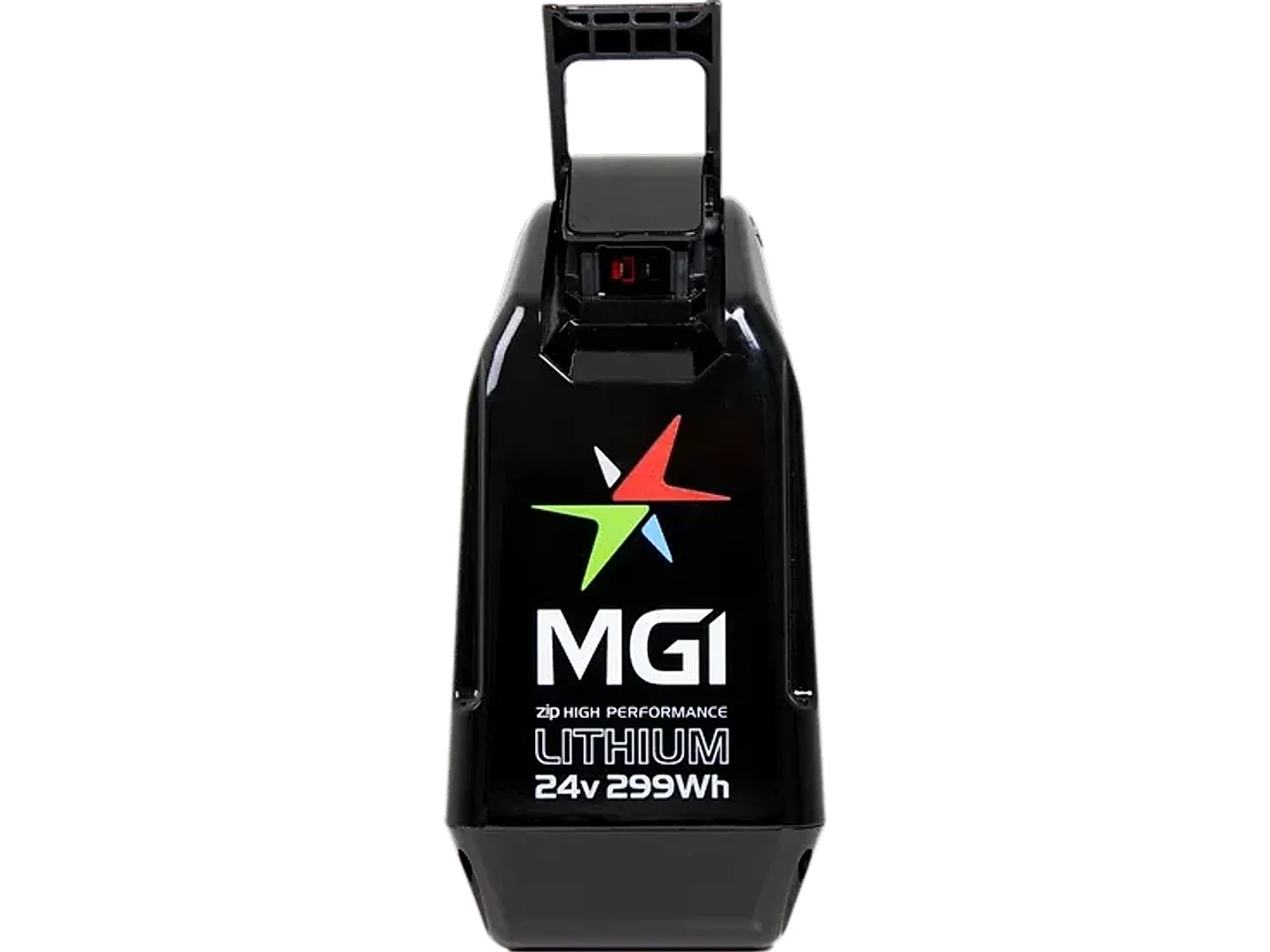
MGI 24V Lithium Battery (24-Spindle / 36 Hole)
24V 380Wh Capacity, Advanced BMS, Click & Go Design. Available for immediate dispatch from our Yatala QLD depot with nationwide enclosed delivery.
More Australian Golf Buggy Guides
Golf Buggy Winter Storage & Long-Term Care: Preventing Deep Discharge & Electronic Faults
Proven off-season care tips for electric golf buggies across southern Australia. State of charge optimization, moisture mitigation, tyre preservation, and rodent deterrence.
Must-Have Golf Buggy Accessories & Spare Parts in Australia: From Umbrella Mounts to Sand Buckets
The top 10 essential golf buggy accessories and replacement spares for Australian courses. Sun protection, sand buckets, drink coolers, and spare wheels.
Electric Golf Buggy Troubleshooting Guide: Diagnosing Motor, Controller & Solenoid Faults
Step-by-step diagnostic guide for common electric golf buggy problems. Learn how to test solenoids, identify controller LED error codes, and source spare parts.